
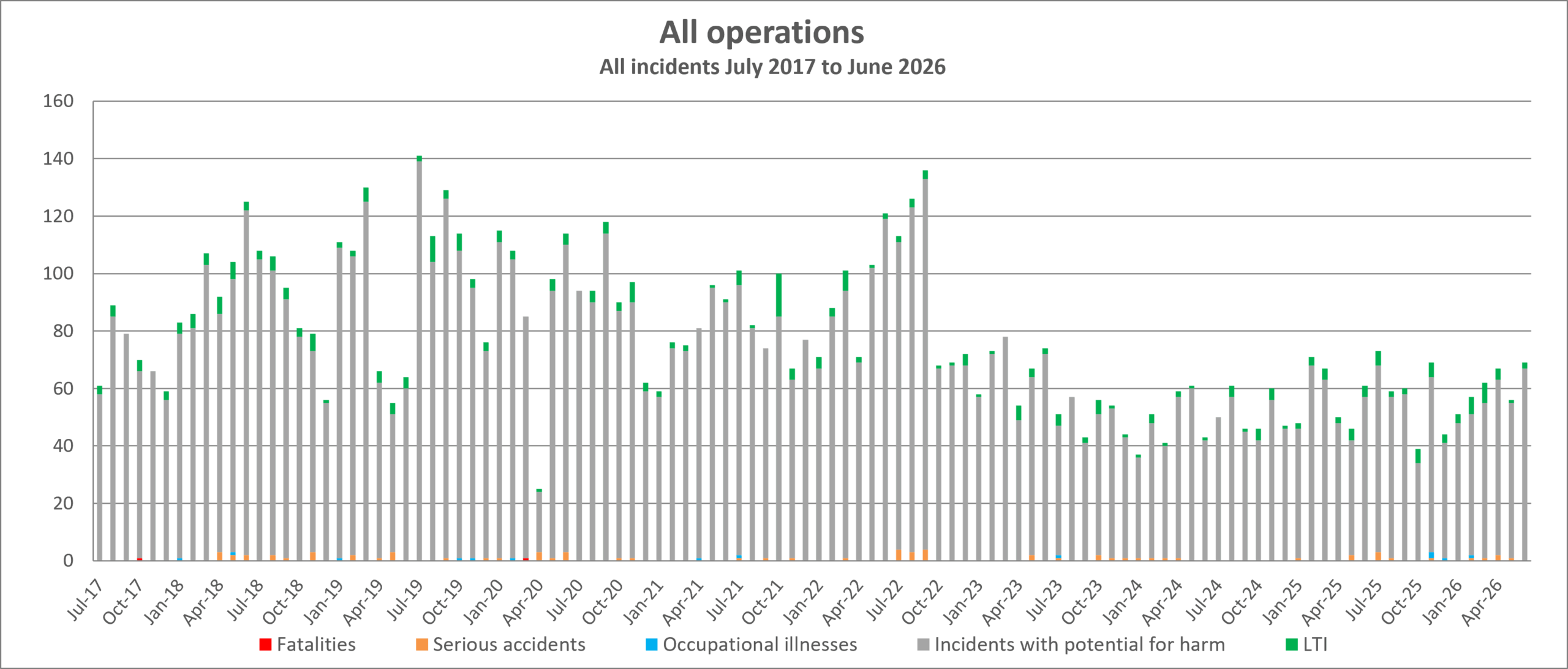
Quarterly, MinEx gathers and collates data from companies that reflects the number of person hours worked and the types of incidents that have occurred.
The data is shown for two sectors of the industry as well as an overall summary:
- Industry-wide
- Underground operations
- Surface operations
If your company does not currently supply incident details to MinEx, it would be great to include you in these. The incident reports are really important for keeping track of how we are doing as an industry, and where to focus our efforts to help reduce incidents and near hits. All information received is treated as confidential. Contact us
View the latest health and safety incident statistics here.
|
Definitions |
|
|---|---|
| Collision |
Includes:
|
| Entanglement |
Includes:
|
| Environment | Includes ventilation, gas, dust, noise. |
|
Falls |
Includes:
|
|
Fatality |
A fatality is a death resulting from an incident of hazardous exposure involving work, regardless of the time intervening between injury and death. |
|
Hazardous substances |
Worker exposure to hazardous substances. |
|
Hours worked |
The total number of hours worked including overtime and training but excluding leave, sickness and other absences. Used to calculate incident rate. |
|
Incident with potential for harm |
An incident that, under different circumstances, might easily have resulted in a serious injury, fatality or catastrophic loss. |
|
Lost Time Injury (LTI) |
Lost time injury or occupational illness resulting in an inability to work on the next rostered day or shift subsequent to the injury occurring. |
|
Medical Treatment (MTI) |
A work-related injury or occupational illness that is not an LTI and which results in injury or illness that requires medical treatment at a higher level than first aid, generally from a doctor or a related professional such as a physiotherapist |
|
Occupational illness |
An occupational illness is any work-related abnormal condition or disorder, other than one resulting from a work injury, caused by or mainly caused by exposures at work which results in an adverse reaction within a body system. |
|
Occupational injuries |
Minor injuries from work activity including cuts, bruises, sprains etc. |
|
Release of pressure |
Includes:
|
|
Serious accident |
A serious accident is an incident which results in admittance to hospital for treatment. |
|
TRIFP |
Total Recordable Incident Frequency Rate (TRIFR). TRIFR rate is the rate of recordable injuries that occur per million hours worked, TRIFR is calculated as the number of Lost Time Injuries + Significant Injuries Restricted Work. |